
The Dashboard Was Never the Destination
It is hard to ignore the recurring and painful conversation in my client meetings. We will be reviewing a dashboard that has been launched, and the topic of active users comes up. The dashboard may be well-designed, logical, and genuinely useful for anyone who takes the time to use it — but it still lacks engagement. A dashboard, more than ever, is not the right delivering mechanism for many people.
It is like the old saying: “As a child, I wanted a house made of chocolate. As an adult, I know that it won’t stand up to the summer heat.”
In the abstract, people are eager for the insights that may come from the dashboard. In our busy world, people often don’t have the time for the learning and exploration that a dashboard requires. Asking a school administrator, physician, sales person, or manager to step back and take the time to act as an analyst is the fantasy of a candy cabin in the woods.
We've been grappling with the challenge of “the last mile of data” for a long time at Juice. And its becoming clear that even the most beautifully designed interactive analytical experience may be less of a destination than a stepping stone.
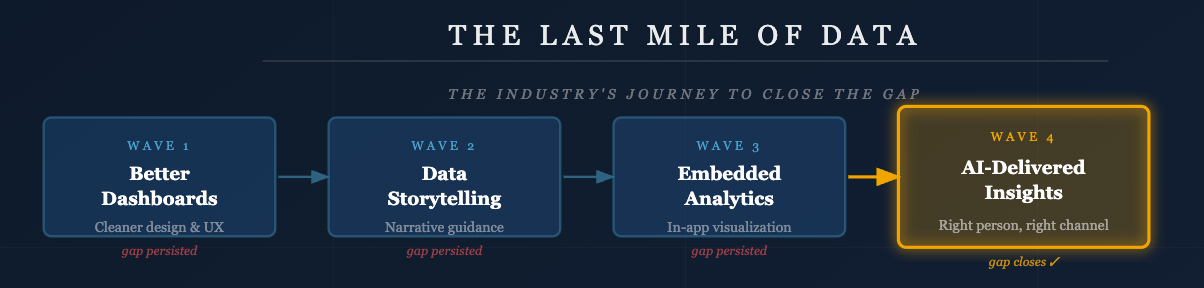
Our Own Journey Through the Gap
We've spent years working on the space between data and the decisions it should inform. It's a stubborn gap.
The first wave of effort in our industry was simply building better dashboards with cleaner design, more intuitive interaction, smarter data visualization. We put real craft into this, and it mattered. A well-designed dashboard is meaningfully better. But engagement still lagged. Users who were motivated found them useful; users who weren't motivated didn't show up. Better design moved the needle without closing the gap.
Then Juice, and the industry, moved toward data storytelling: dashboards that incorporated narrative flow, contextual guidance, and interpretive text rather than just charts and filters. Instead of presenting data and letting users draw their own conclusions, we gently guided users toward insights. This was a more balanced, streamlined mix of exploration and explanation, and a real step forward. However, we were still asking people to open a tool and engage with it on its own terms.
A parallel and overlapping trend was embedded analytics where we put the visualizations directly inside the applications users already live in. It made sense to visualize the data in the CRM, the learning management system, or the EHR. Stop asking people go somewhere else. This helped close the gap through greater convenience, but as we kept discovering, the applications people use for their work aren't quite where decisions get made.
Decisions get made in Slack threads and email chains and Teams conversations and across conference tables. Someone shares an insight and a dozen people react to it. If the data isn't in those conversations, it's largely absent from the decision. Every step we took brought us closer to the user, the destination was always further than we thought.
What Dashboards Got Right
An argument that often gets lost in critiques of dashboard is that the work of building a dashboard is itself valuable, even if no one logs in.
Designing a dashboard forces an organization to think. You need to decide what actually matters. You have to define the right metrics, agree on how they're calculated, and make explicit choices about what questions deserve answers and what context those answers need. That synthesis, a process of deciding how a business or a customer should look at their data, is critical work. You are discovering the most important stories to tell.
We might start to think of a dashboard less as a destination and more as a specification: the organization's best documented thinking about what the data means. That documentation doesn't become worthless the moment someone decides not to log in. It becomes a meaningful foundation for everything built afterward. A well-constructed dashboard is actually an excellent jumping-off point for narratives and automated insights, precisely because it already contains the framing, the metrics, and the context that make a narrative coherent. Skipping the dashboard phase doesn't simplify the problem; it just tries to bypass important work.
The critique isn't that dashboards shouldn't be built. It's that delivering a dashboard to an end user and calling the job done turns out to be the wrong stopping point.
The Analyst Assumption
The analytics industry, Juice included, made a foundational assumption that turned out to be wrong for most users. We assumed that people, given a sufficiently intuitive interface, would want to explore data themselves.
That assumption drove a decade of product development. If people aren't engaging with the data, it must be because the tool is too hard to use. So we made the tools easier. We added filters that were easier to understand, charts that were easier to read, layouts that required less training. Unfortunately engagement still didn't follow at the scale we expected, because the problem was never primarily about the tool.
The audience for self-directed data exploration is smaller than the analytics industry assumed (or wanted investors to believe). Certainly, there is a real population of users who come to data with a specific question, the context to interpret what they find, and the inclination to dig. Analysts, data-fluent managers, researchers: these users are well-served by dashboards and will advocate for them. But teachers with thirty students, healthcare coordinators managing complex caseloads, sales representatives who live in their CRM — these are people too deep in the activity of their roles to step back and become analysts, even temporarily. They don't want a tool that makes exploration easier. They want the insights brought to them, in plain language, in the context of a decision they're already in the middle of making.
The error wasn't building dashboards. The error was assuming that the dashboad-eager audience represented the majority of users.
What AI Changes
This moment feels different from previous attempts to close the gap due to what AI can enable. Finding a pattern in a year's worth of data, framing it as a plain-language observation, and routing it to the right person in the right channel is no longer as complex a challenge as it once was. These things can happen at scale given the appropriate use of AI.
And there's a broader cultural shift supporting this. People are increasingly comfortable letting technology handle the steps to get to a destination, as long as they retain control over what gets done with the result. Whether something is lost when people skip the exploratory journey is a fair debate — there's genuine value in the process of discovery that doesn't show up in the final insight. But for the large share of users who were never going to explore the data anyway, the tradeoff is obvious. Getting a clear, relevant, well-timed insight delivered to you is fundamentally better than having access to a dashboard you never open.
A More Honest Map of Who Needs What
Dashboards remain exactly the right tool for users who arrive with specific questions, the fluency to pursue them, and the time to dig. That audience is real and matters.
The better mental model is sequential rather than competitive. Dashboards do the hard work of defining what matters and how to measure it. Narratives and automated insights take that definition and deliver it to the much larger audience that needs the answer without doing the analysis. The two aren't alternatives to each other; one creates the foundation the other builds from.
Most organizations have spent the last decade building almost exclusively for the analysts. The shift is recognizing that the rest of the audience has always been there, has always needed something different, and now has tools that can actually reach them.
The data exists in most organizations. The frameworks for interpreting it exist too, often carefully encoded in dashboards that someone spent months building. What's missing is the last leg of the journey: getting what those dashboards know out of the tool and into the conversations where people are actually deciding things. That's the problem Juice is solving with our latest capabilities. Check it out at https://www.insightsrecap.com/