In Pursuit of "Elegant Solutions"
By Zach Gemignani
January 30, 2007
Find more about:
A Friend of Juice pointed me at a recent dispatch from the Change This web site entitled Elegant Solutions. If you aren't familiar with Change This, it is worth a look. It is an outlet for big thinkers to publish "manifestos" on (mostly) business ideas ranging from marketing and customer service to strategy and innovation.
This particular manifesto by Matthew E. May (a trimmed down version of his book by the same name) reveals the secrets behind innovation at Toyota. It offers a number of themes that resonate with the discussions on this blog. A few of the high points:
"Toyota is in pursuit of 'elegant solutions to real world problems.' Not grand slam homeruns, but groundball singles implemented all across the company by associates that view their role not to be simply doing the work, but taking it to the next level... An elegant solution is one in which the optimal outcome is achieved with the minimal expenditure of effort and expense... [and is] is recognized by its juxtaposition of simplicity and power."
"Great innovation requires understanding and appreciating the concept of elegance as it relates to solving important problems. Oliver Wendell Holmes once said: 'I would not give a fig for the simplicity this side of complexity, but I would give my life for the simplicity on the other side of complexity.' This is one of my favorite quotes—certainly my favorite by OWH.
Elegant solutions avoid the traps of: 1) Swinging for the fences; 2) Getting too clever—i.e. too many bells and whistles; 3) Solving problems frivolously.
"[Innovation] requires that we work the way artists or scientists do: accept the limitations, use them to our advantage, and pursue the simple question that drives the thinking behind every breakthrough, big or small: Is there a better way?" This idea of embracing constraints, which we wrote about a while back, is becoming increasingly embedded in business thinking.
"Artists and scientists own their work and sculpt their job. That’s new school. It’s a different mindset, and anything different is risky... New-schoolers know they’ll get pushback, but they trust their abilities, and continue to employ their ingenuity to explore and experiment with new ways of doing things within the confines of the organization." Chris and I are sons of an artist who quit his job to pursue his dream of painting. That lesson stuck.
"Real learning is a cycle of questioning, experimenting and reflecting. It’s how we convert curiosity into an innovative solution." This is a theme we constantly re-enforce with our clients—analytics is a journey of discovery. The end goal isn't a report or analysis, it is a step that will reveal new understanding and help you ask a better question next time.
"Elegant solutions often come from customers—get out more and live in their world.... go look and see to fully grasp the situation; then, and only then, define the problem and design the appropriate solution." We have been a proponent of looking at the raw data that describes individual customer behaviors--alternatively, there are companies like Lextant that specialize in helping businesses get closer to understanding customer needs.
"Focus on clear and present needs, or your great ideas remain just that. Make sure you’re concentrating on a real need. Don’t confuse an unarticulated need with a non-existent one. Don’t attempt to manufacture a need." This is the fundamental problem with many data warehouse and business intelligence projects--in their attempt to be comprehensive, they minimize current needs and frequently miss the mark on future needs.
"Pictures and images connect people to thoughts and goals and help turn valuable ideas into action. So get graphic. Whenever you can, wherever you can, start building a visual element into your thinking... Digging into relevant data helps fight the dangers of bias, convention and instinct. There’s nothing better to help make the break with comfortable patterns than solid evidence. " Preaching to the choir.
"Be-all, end-all, feature-rich solutions almost always miss the mark. Because they’re over-scoped and too complex. They’re usually proof that we lack real insight into our customer’sdesires. Complexity destroys value, which is what matters most to the customer. The most elegant solutions always seem blazingly simple." Isn't that just the way it is with many BI solutions?
Instant Shopping Lists, or...How Excel Can Improve Your Marriage
By Zach Gemignani
January 26, 2007
Find more about:
excel
humor
tools
Sunday mornings at my house:
Wife: "What do you want for dinners this week?"
Me: "Dunno. Something easy."
Wife: "Think of something."
Me: "Bratwursts?"
Wife: "Something real."
...
And so it goes, every weekend. Making the weekly grocery list is one of those tedious tasks that feels like an unavoidable mallet to the brain.
My friend Cathy decided to do something about it—she built an Excel tool that helps her pick dinners and automatically build a list of ingredients. This Recipe Manager is a fine feat of Excel engineering and she has been kind enough to let us share it with our readers.
Step 1: Use the handy recipe input sheet to add new items to your list. Tip: Only add ingredients that you don't normally stock.

Step 2: Select from drop down lists of dinner options--one for each day of the week. The dinner suggestions area at the bottom randomly selects a set of recipes to provide some fresh ideas.

Step 3: Print out your automatically generated shopping list.

Download Cathy's Recipe Manager here. It may just free up some quality time.
12 comments | Show all comments only the last 5 are shown
George said:
This type of thing is just spot-on in terms of making life and tasks like this much less painful...dare I even say 'fun'. Maybe not that far. Perpetually unsatisfied though, two things missing from this app, at least as shown in the blog are: 1) A way for my wife to enter rules so that I can't select PB&J every night of the week, or even more than once every 3 months, and 2) automatic consolidation of ingredients (i.e. Monday needs 1.5 lbs of Chicken breast and Firday needs another 2 lbs. --> the grocery list should have me buy 3.5 lbs or recommend that I find two separate packages because the meals are more than X days apart (for fear of bacteria growth or something), but it at least lists them next to each other in the list for efficiency's sake.) There's few things worse in my sheltered world then having to return to the same part of the store again and again because items were out of order in the list compared to the store layout...which is a whole other possible product offering/service that might be interesting.
Robbin Steif said:
I sent this to my husband, the cook. As much as we loved it, we agreed that the hard part is not the ingredients, the hard part is getting the family to say what they want. He says, "What do you want for dinner this week?" and we say, "Whatever."
But your stuff is great, keep it up.
Alan Rimm-Kaufman said:
One problem with the prepopulated Excel shopping list approach is that if you're not careful you end up buying the same stuff and cooking the same recipes week in and week out.
:)
Alan
makingmark said:
this is an interesting idea.
but one of the things about living in new york that i love is, i walk to grocery stores. so typically, i only buy about 2-3 days worth of groceries, at most.
when i lived in texas i would buy a weeks worth--but then friends would invite me out, i'd decide that what i'd wanted to eat 5 days ago isn't what i want to eat now...leading to wasted food. also needing to go to the grocery store to buy a weeks worth of food would "hang over my head" like needing to do 4 loads of laundry...
as i get older, i'm trying to live more and more by the idea that even if it seems more "efficient" to chunk up a lot of a repetitive task at once, it's more effective to break these repetitive tasks, which are boring and tedious, into small manageable pieces. e.g. iron 2 pants and a shirt, not 15 of each.
i grant that it's a lot easier for me to live this way as a single guy...
Carm said:
I LOVE this. Thank you for sharing. When I first looked at it I was concerned because the dropdowns did not have the recipes in alpha order so it was a little difficult to find the one you wanted. But then I figured out that I could sort the Recipe Main sheet by recipe and voila - alphabetized dropdowns.
Thanks again.
Henk said:
Alan, you triggered me: you can make the lists dynamical, I think. It just picks from a list that can be extended. It works like dynamic range names - same you can "grow" a chart everytime data is entered.
All about food « Pico DiPaolo said:
[...] Oh that reminds me of another thing that Petie and I have been meaning to try - this one I found on Juice Analytics…Cathy’s Recipe Manager is similar but you put your own recipes into this Excel spreadsheet and it creates the shopping list for you. We really will try this soon. [...]
HS said:
Great job! At least someone thought about this. One improvement to the sheet (yes we got suggestions now that someone bothered to make this thing) would be to group the ingredients by aisle/ food section. Ideally (and this may be too idealistic), if I shop consistently from Kroger or Costco, I would like to have a shopping list which gives me a list of items to buy from each aisle--that would speeded up my shopping.
But once again..great job, Cathy!
Samuel said:
Have any divorces or outbursts of violence been reported when an innocent spouse suggested this method to the other computer-hostile spouse?
But seriously, this would be a perfect application to initiate on an Apple user-friendly type package complete with warm and fuzzy ad campaigns that would make any couple feel like dunces for not adopting this new and smarter way of doing things.
Of course, I have just the agency that could manage the whole project, making all of us rich beyond our wildest dreams.
Intrigued? Yawning? if the former , write me and we'll make it happen, yes, and soon. As Madam Ruby might say, 'I see great things in your future..."
Maryanne said:
This is an awesome tool! Many thanks for sharing.
Laurel said:
This really is very creative and helpful, nice work Cathy :)
Krista said:
I was absolutely stoked when I found this. But, um... isn't there 7 days in a week? I can't work out how to add another two days. My excel skills do not extend that far. I don't suppose anyone knows how to do this??
Add a comment
Analytics Roundup
By Chris Gemignani
January 25, 2007
Find more about:
data
ibm
visualization
- Many Eyes: IBM's collaborative visualization
- Fernando Vargas' vision comes to light.
Databases are Rocks, Spreadsheets are Water
By Zach Gemignani
January 17, 2007
Find more about:
excel
Sean McGrath offers a brilliant description of the relationship between spreadsheets and database applications. No commentary required.
"Think of your centralized database applications as a set of large rocks. Their great strength is their solidity. Their great weakness is their lack of flexibility. Think of spreadsheets as the water that flows over and around the rocks. Their great strength is their flexibility. Their great weakness is their lack of solidity. The easiest route to the far side of a rock is to be like water and flow over or around it, rather than to change the nature of the rock."
"Would you mind repeating that more slowly?"
"No problem", said Master Foo. "Database applications have rigid structure and rigid behavior. If a business process exactly matches the structure and behavior then nothing inhibits the flow of business processes. As soon as the rigidity becomes a problem, users will seek to find the quickest way around the rigidity. This often takes the form of spreadsheets that supplement the data and the behavior of the centralized systems. Spreadsheets do not involve getting the IT department to do anything. Nobody even needs to be told. The spreadsheets can be stored locally. Individuals can set up their spreadsheets to model how they themselves work. They have complete control."
A cold sweat formed on the brow of the CIO.
"Over time, more and more key information lives primarily in the spreadsheets rather than in the centralized data stores. In advanced cases of this phenomenon, it is the expense centralized enterprise applications that can be destroyed without causing a noise at board level because individual, local PCs hold the true enterprise data in an amorphous assembly of spreadsheets."
(Via James Webster at The News Before the News)
10 comments | Show all comments only the last 5 are shown
brooks said:
This is all true, but the widespread use of spreadsheets also has some problems.
For example, the construction industry is obsessed with spreadsheets. They track everything from document flow to job cost and in many cases this works great. But when working on a $250,000,000 job, tracking budget and cost on a spreadsheet is just asking for trouble and this is when a database-backed solution is the better solution.
Spreadsheets may have an error in the formula on row 243 that throws off the whole budget and makes the cost engineer think that he's got some amount of money in his budget that he really does not... and this stuff happens all the time.
So while I love spreadsheets and use 'em all the time, they're not great for everything.
And that last paragraph is really scary - and TRUE.
David A. Heiser said:
There has benn enormous efforst to reduce computer sizees. Visualisze the Excel spreadsheet that uses company data in an ipod or cell phone. Excel users modifies and builds a spreadsheet outside od the central company information technology center. Visuallize now many, many employees doing this. Visuallize now with new 21st centrury devices that link computers directly to the brain (see the PBS series "22 Century"). These are now in existance. Visualize now that important company information now resides in this link, and may not be able to be be recaptured as a formal spreadsheet structure.
DAH
Henk said:
Water is fluid, soft, and yielding. But water will wear away rock, which is rigid and cannot yield. As a rule, whatever is fluid, soft, and yielding will overcome whatever is rigid and hard.
(Lao-Tzu, 600 BCE)
Jorge Camoes said:
Let me quote the TV series "Yes Minister" (from IMDb):
[Discussing a hospital that has 500 administrators, but no doctors, nurses, or patients]
James Hacker: You think it is functioning now?
Mrs. Rogers: Minister, it is one of the best run hospitals in the country. It is up for the Florence Nightingale Award.
James Hacker: And what is to praise that?
Mrs. Rogers: It is won by the most hygienic hospital in the area.
Too often the corporate information system forgets to walk the last mile and give the users what/when/how they need. They have "the most hygienic" system because people don't use it (so they have no complains, which is great, isn't it?).
TCH said:
I agree with the basic points made -- databases allow rigorous control of data; spreadsheets provide the flexibility of asking and analyzing every eventuality that arises, not just those that are built into a database construct.
So, my practical question is -- what's the balance? Realistically, how can we evolve a system that provides the best elements of both, or is that a pipe dream?
Andreas Lipphardt said:
You have to combine the strength of both worlds with an Excel friendly OLAP. A spreadsheet is very flexible and quite accepted by business users. An OLAP data base is a real database, like a spreadsheet on steroids, with a rigid structure and is very scalable. So just provide your users with a seamless Excel integration. Give them an easy to use OLAP database tool that allows them to build OLAP databases themselves without IT involvement. TM1 uses this approach for many years and is very successful with it. Even Micosoft started to better understand the needs of business users and now has a very good OLAP integration with Excel 2007.
Nigel Pendse wrote an excellent article about the relation of spreadsheets and databases: OLAP and spreadsheets - friends or foes?
http://olapreport.com/purchase/Reviews/Spreadsheets.htm
Jeff Carpenter said:
This is a great metaphor for two information management extremes but as previously commented, there is some middle ground.
Ventana Research expects the emerging <a href="http://www.intelligententerprise.com/showArticle.jhtml?articleID=196701574
"> Spreadsheet Management Market</a> to explode in the next few years (from $15M in 2007 to $500M in 2011).
As this market grows, OLAP will certainly play a more and more critical role in extracting intelligence from these managed spreadsheets for decision support.
Anyone care to complete the metaphor: Mud? Gravel?
-Jeff Carpenter
<a href="http://www.agilegraph.com" rel="nofollow"> www.AgileGraph.com</a>
Linda Ewen said:
You have been exposed to some bad databases. Good databases are very flexible and will withstand an extraordinary amount of change.
Al said:
Everybody has been exposed to some bad databases, but that doesn't change the fact that spreadsheets are more flexible. (Remember, users, not programmers and database administrators.)
He's not saying databases are bad. He's saying databases have a strength, and spreadsheets have a strength. If there was a database which was both as solid as Oracle and as flexible as Excel, surely it would have beaten both of them by now.
fd said:
I work at a place like that and in my experience the reason for the proliferation of spreadsheets is not so much that the database can't do what's being done on the spreadsheet, it's that IT won't give anyone actual SQL access. Everyone has to get the data through canned queries on spreadsheets (that don't do what the business needs) and then have to cut and paste these things into Excel or Access and write VBA or Access queries to create what they actually need. Of course someone that knew SQL could have just extracted it that way from the DB...
Add a comment
Communication that Sticks
By Zach Gemignani
January 15, 2007
Find more about:
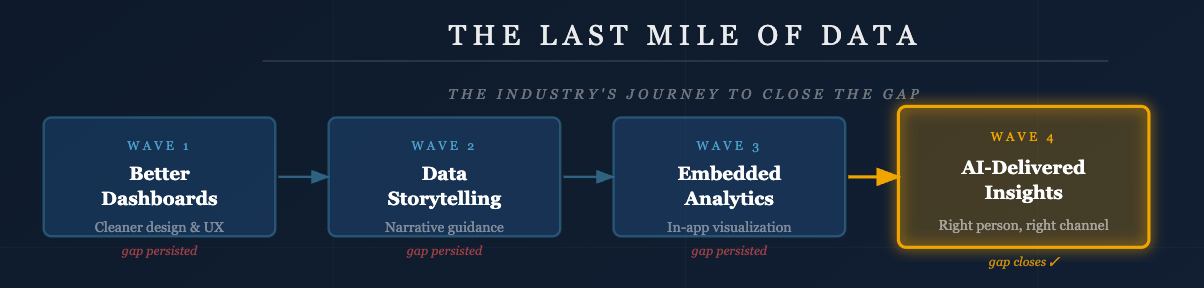
The last mile of business analytics is poorly paved. Most of the effort and investment has been put into gathering, centralizing and warehousing data; relatively little time is spent on thoughtful, creative analysis and ensuring that results are communicated into the minds of the decision-makers. It is this last piece that may matter the most.
We can construct engaging stories from the data and put together winning PowerPoint decks, but the window of opportunity to communicate our results always seems frighteningly narrow. Weeks of analysis and synthesis can get crammed into a single 30-minute agenda-item. The cramming part isn't so much the problem (it demands focus on the key results—I am more concerned about the fleeting attention of an audience that has a dozen other priorities, is awash in information, and may be data-phobic. Not to mention the risk of getting derailed by conversations about the data sources and statistical significance.
How can we share our analytical results in a way that will stick to the distracted mind of an executive? Moreover, is our obsession with top management misplaced when insights about the business should be spread to all levels of an organization?
One place to start is to consider how to break through the cluster of information with creative communication techniques. Here are a few ideas—I'd be interested in hearing your ideas or success stories:
- Catch them in their downtime. At one client, we created flyers that showed the results from a customer survey and posted them in the bathroom stalls under the title "Learn as you go." We gave a captured audience something to read. Maybe we were too timid—why not go all the way with custom-printed toilet paper?
- A new format. When traditional slides seem to numb your audience, maybe a new information format is in order. Try a science-fair type poster, a web page, or a short book (check out self-publishing with Lulu). We once created a movie (Windows Media only) to show customer behaviors; a year later I got a request to show the movie in order to re-establish the key message. That's sticky.
- One-page summary. Provide your audience with something to take away that summarizes your key messages. You might hand out (or stuff mail boxes with) a laminated one-pager with your most important framework and results. A colorful summary that begs to be thumbtacked to an office wall is better than a 40-page black-and-white deck that begs to be thrown out.
- 10' display. It seems to be in vogue for companies to have big TVs in the lobby to stream corporate propaganda to the minions. Reach out to corporate communications to see if you can get into the program.
2 comments
derek said:
Thirty minute agenda item!? Ee, we used ter *dream* of getting a thirty minute agenda item!
Thirty minutes? Bloody looxury.
dan said:
First, love the blog!
Second, yaaah.. ways to communicate so it sticks!
One Page Summary, our brand folks love this one alot and clients with that particular slant dig it as well, doesn't always work for other ventures. We always strive to be able to sum up the reseacher in a one pager like way if possible. Data needs to be digestible for all.
Video, over and over and over again, video proves itself as a powerful communicator. Mix video with data results (think popup video on vh1) and make them see the actual experience unfold and the data points to stress.
More visualization needed. The challenge lately is to get more of our data to be all funked up via a digg swarm like dealio. Make it flow, cool, browse able and so on. I remember the days playing with Visual Thesarus and thinking "damn.. we gotta apply this model to some data".
Storyboard Playback. We're doing alot more with a kind of mission statement or story playback that gives the client the story of the ideal experience along with the data points, especially in multi-sensory research that play into that story along the way. You read the story and see the stimulus people refered to that made them feel that way. You give the design team all the bits.
But ya overall, making data cool is a frickin challenge, but yer blog is helping!
Add a comment
Rodney Dangerfield of spreadsheets
By Juice Alumni
January 15, 2007
Find more about:
excel
Poor old Mac Excel, it just don't get no respect.
It's different enough from PC Excel to strike uncanny valley fears into the unwitting. The next versions will exclude built-in VBA much to the chagrin of the Mac business faithful. The uproar reminds me of when Lotus announced it would pull LotusScript, a VBA-like language, out of its Notes program. People were openly revolting (although nothing was quite as revolting as Notes development).
So, if you don't have Parallels or the like, it's pretty much the only choice you've got on OS X. Sure, you can use Open Office, but that comes with its own peculiarities and incompatibilities.
One tip I'd like to share is how to silence this much maligned program. If you're using anything other than the built-in speakers on your Mac, you'll find that people in other parts of the office tend to jump out of their chairs when you hit Save. Mac Excel blings, clicks, and whirs with wild abandon.

You're just one click away from the sound of silence and passing this along is almost always met with "oh, you can do that?" squeaks of delight.
6 comments | Show all comments only the last 5 are shown
Miguel Marcos said:
I wouldn't put down OpenOffice as a decent alternative (actually, NeoOffice, based on OpenOffice, is the best).
At work I depend on Offce2000 (especially Excel) and SQL Server 2000. VBA work is a huge part of my livelihood. So I know quite well what's missing from the Mac version. I also believe it was a mistake to remove VBA. However, given that fact, NeoOffice is quite a nice alternative on its own with a strong level of compatibilty with Microsoft Office. If you add zero cost of ownership then it becomes quite attractive. I have Parallels on my Mac at home but if any Mac owner were to ask me about this issue I'd point them to NeoOffice first.
Rob Fay said:
That's a shame since I use a Mac at home. There is an alternative, however, to purchasing Parallels and a copy of Windows - Mac users can bypass purchasing Windows by purchasing <a href="http://www.codeweavers.com/products/cxmac/" rel="nofollow">CrossOver</a> and a copy of Excel.
Jules said:
Thanks, Miguel. I had one of those 'ho hum' feelings about NeoOffice in the 1.x line. It was a little too slow to be usable for my needs. Perhaps I need to download the 2.x version and see where it's heading. The <a href="http://www.neooffice.org/" rel="nofollow">Web site</a> claims "Open XML and VBA Macro support in Q1 2007" so it's certainly worth a peek.
Given Novel's input into NeoOffice and their recent deal with Microsoft perhaps this might just have legs.
Jules said:
Good point, Rob. My primary, pre-OS X laptop used to be a Thinkpad so I'm familiar with CrossOver and <a href="http://www.winehq.com/" rel="nofollow">Wine</a>. Stability was a major issue even a few years ago so I'm guessing CrossOver has made strides if you're recommending it.
How well does it play with OLE, um, I mean COM... no, DCOM? Uh, COM+? What are they calling it this week?
Rob Fay said:
Actually, I cannot vouch for its goodness since I have not yet upgraded to an Intel-based Mac. However, the CrossOver site has user-supplied ratings concerning how well some pc software plays on the Mac using this tool...
George said:
Codeweavers just released version 7.0 of Crossover for the Mac, but I'm disappointed to report that running Excel 2003 VBA macros is still problematic. It may be that Excel 2007 is better supported. I do not own Excel 2007 so, short of purchasing it, I will have to rely on the comments of others to learn whether it runs without hitches under Crossover.
Add a comment
Excel Training Worksheet
By Zach Gemignani
January 7, 2007
Find more about:
excel
Click here to download our much-delayed Excel training document. It is chock-full of tips, tricks, and exercises to sharpen your Excel skills.The training covers many of the areas discussed in our post on "Essential Excel Skills." Here's the outline:
1. Getting started
a. Keyboarding
b. Absolute and relative references
2. Data and functions
a. Find and replace
b. Date and time
c. Functions
d. Text functions
e. Vlookup
f. Data filters
3. Presenting data
a. In-cell graphics
b. Conditional formatting
c. Chart Exercises
Please share your thoughts on weaknesses or gaps in this document. Better yet, send us additional training content that we can include in the next version of this file.
31 comments | Show all comments only the last 5 are shown
David Freccia said:
Looks good! I'll soon be using the clever in-cell graphing, and conditional formatting examples 2 & 3 on some larger tables.
A quick note: check cell F17 of "Absolute vs. Relative references." It looks like the formula should be $c$10, not $c$60.
Paul said:
Hey, I just started reading your company's blog. Some really interesting stuff, keep up the good work!
Loved the Excel tips. The only thing I would add is that if you are doing sheets of numbers and want to include the REPT function to add some nifty graphs, you can add a full block (under add symbol) to once cell in the sheet and use that as the character in REPT. This actually gives you solid bars that look exactly like Excel charts. Repeating the "|" character looks a little strange, imho.
Looks like there will be no need for this in the new Office release though, I think there is some type of cell shading function/bar function based on the cell's numeric value. Haven't played with a beta release so not too sure what it does exactly.
Paul
Paul said:
lol, I've just seen the original thread for the in-cell Excel graphics - I think my idea has already been mentioned previously - at least 100 times!
Paul
We Can Fix That with Data / Excel Training said:
[...] Juice Analytics’ Excel training worksheet is available for download. It covers their previously identified core Excel skills. [...]
Henk said:
Some quick comments:
- Very useful to a quick and basic understanding what you can do with Excel. Many people tell me they know Excel, but often not so quite ...
- I like the what-why-how pattern.
- I miss general sheet design principles. There is barely a structured approach available (a huge lack - and a genuine opportunity), e.g. to separate parameters in different cells, to plan ahead, to document yr formulas, to colour input cells, to breakdown into more cells to facilitate troubleshooting, to use names for parameters rather than referenced cells to ease reading formulas, etc.
- In "absolute vs relative references", I wld add the other two options (relative col- absolute row, and v.v.) Also, mention F4 to toggle (I see many people manually add the $).
- I don't like "always FALSE" in yr VLOOKUP instruction. Especially in huge dBases this can be painfully slow. I do agree that TRUE can give problems, but I think the absolute statement is a step too far. I suggest to change into "always use FALSE, unless you hv a reason not to" (ok, this looks like I am a lawyer - forget it).
I hope these comments don't sound negative. Overall it's very useful. You guys continue to impress me. Keep up the good work!
Hadley said:
This is a great idea, and I'll be using it with my stat computing class this week.
The only thing I don't like are the charts with two axes - this is a bad idea! It's very easy to manipulate the scales to mislead. I think it is better to use two charts, clearly illustrating that there are two different data sources (and leaving no doubt which axis belongs to which series).
chris said:
on Keyboard Exercise 3, Control-Shift-* selects the current region, so you don't need to use the arrows keys.
Andy Wall said:
Good as far as it goes. It's the kind of thing I feed as tidbits to colleagues when I am feeling generous :)
But I too (like Henck) am waiting with bated breath for more on Data-Transform-Present, sheet design and so forth.
Keep up the good work
chris said:
The document looks great, but I might add a tab on managing printing from Excel. Kill the gridlines; center Horizontally; fit to 1 tall 2 wide; and, columns or rows on multiple pages are everyday things that users may need an introduction to.
Keep doing what you are doing. Great stuff.
links for 2007-01-10 « genericface blog said:
[...] » Excel Training Worksheet - Juice Analytics A surprisingly helpful tutorial on Data Organization in Excel. (tags: tutorial excel) [...]
Neil said:
Just a minor point. In your keyboarding examples, you use Alt-E-D-R and Alt-E-D-C. In my experience, Ctrl+- (Control and minus key) instead of Alt-E-D is easier to remember, as well as being one keystroke less.
Cujo said:
Several comments:
1) Just discovered your site. Love it. Been wanting to get some Excel chops, and this seems a good starting point.
2) Shout out to my homeys (I live in Reston).
3) Wahoowa! (PhD in CS, 1995).
The News before The News » Excel tips to impress your friends said:
[...] If you happen to find yourself surrounded by Excel gurus and are having trouble keeping up, as anyone who is new to the financial industry may find, you might find Juice Analytics’ Excel Training Worksheet handy. [...]
Jena said:
I regularly have to export contact information from our database, and I never knew a function could split the full name into two columns. Thank you for sharing this tip!
CX Now - Skapa dashboards i MacroMedia Flash av dina Excel-filer « Moustache Analytics said:
[...] Now - Skapa dashboards i MacroMedia Flash av dina Excel-filer Jump to Comments Oftast när du ska visa dina sälj- eller kunddata har du samlat på dig det i Excel och sedananvänder du de diagram som finns där för att visa utfallet. Dessa diagram är inte alltid så upphetsande och givetvis kan du göra dem snyggare antingen genom träning eller andra program som skapar snyggare Flash-diagram såsom Swiff Chart från Glob FX. Det program som jag tänkte rekommendera heter CX Now och är gratis och fungerar med Excel-filer som du importerar och konverterar till allehanda Flash-filer för presentationer. Flashspelare finns numera på nästan alla datorer som har en webbläsare vilket gör att du inte har några problem med att mottagaren inte kan läsa filen. CX Nows storebror heter Crystal Xcelsius och har givetvis massa andra funktioner men den har också en prislapp, vilket CX Now inte har. Templates på vilka typer av dashboards du kan göra med CX Now och Crystal Xcelsius hittar du här och här. Vill du kunna skapa mer scenario-inriktade filer och få till en “wow-effekt” (t.ex “om jag ökar min marknadsinvestering med X%, får jag +Y% i intäkter”) måste du lära dig att använda VLOOKUP-formeln i Excel. Juice Analytics har en bra träningsfil i Excel som kan få dig uppdaterad på VLOOKUP och de viktigaste formlerna och genvägarna i Excel. [...]
Wynn said:
This is a great summary and found some things i didn't know. I would consider covering Index/Match as it is totally essential for real excel mastery and much more robust than VLookUp. It's a bit tougher concept, but that's all the more reason to include it. I think that you guys would do a good job explaining it.
Aaron said:
Very nice for beginners. But I thought you guys were hardcore. Where's SUMIF? The database functions? Pivot tables? Using SUMPRODUCT to do SUMIFs with multiple criteria?
Zach said:
Are you calling us out? Would you like dueling spreadsheets at 20 paces?
Fair enough. There are a number of more advanced features and skills that we did not include in this training document. The goal was to lay a solid foundation of knowledge with the features that we use most frequently. Pivot Tables is the notable exception -- there are some pretty decent tutorials on PTs out there and we didn't feel that we could do them justice in the time/space we had.
Michael said:
Great start!
But I have to echo Aaron on VLookup vs. Match + Index. Not only is Match+Index more robust, it also uses less memory and calculates more rapidly. Rather than being an advanced tool, Match + Index should be taught to the exclusion of Vlookup & Hlookup in any excellent Excel training.
Also needed are Indirect() and Offset(), although these are only indispensable for more complex worksheets.
Then there is the little known trick with aggregate functions (such as {=SUM(IF(a1:a10>0,a1:10,0))} ). This is far more powerful than the SUMIF() function. To get the curly braces, use CTRL+SHIFT+ENTER after typing the formula.
I realize you may not choose to include the above, but I figure mentioning them might inspire others.
Finally, the chartjunk example still has an unnecessary 3-D component. Reducing the graph to 2-D, eliminating the grey background, etc. would be an improvement.
Madan said:
I love this site!!!
Yale said:
I just got a new computer with Excel 2007. Confusing?
Where is "HELP"
Where is "Format"
Where is "Tools" "Insert"
How do I "unhide a column"
Is there an instruction manual on line?
Divy said:
.
J - Just
U - Umazing
I - Interesting
C - Complete
E - Excel
Package....
Kudos to team !!!
Mike said:
Great set of worksheets. One complaint - while some of the exercise worksheets contain an answer key, others (notably the conditional formatting one) do not, making it difficult to verify if the correct solution was used.
Paul said:
great stuff; especially the in cell graphics; simplicty all over!!
when summing values of a column which may include #N/A results, rather than IF-fing all rows in an additional column, why not use =SUMIF(range,>0,range)
happy excelling
gaber said:
it is very nice work thanks
her i see an excellent idea about learning excel
i am an ict teacher
can you send me any sheet about ict learning please
asad said:
hello
i have downloaded this training file its really useful, thanks alot.
Billy Gee said:
The keyboard short cuts are great and I appreciate you sharing these for gratis. Just yesterday someone was trying to sell these to me for $3 a pop - okay it was a hard copy and something we were considering giving to our students but I think I'll direct them here. Sincerely Billy.
http://www.trainingconnection.com
Chris Gemignani said:
Thanks a lot, Billy. We always appreciate the props... and the traffic.
Brandon said:
First, let me say that this is a great training tool that I plan on sharing with the rest of the office!
Second, one keyboard shortcut I noticed that is missing is the use of the F4 key to create an absolute cell reference when entering a formula. You can hit this key multiple times while hovering over the cell to toggle between A1, $A$1, A$1, and $A1. This shortcut has proved invaluable to me as I trudge through mind numbing formulas!
Thanks and keep up the good work!
Pepper said:
I would like an exercise in Excel online free for users to practice on their excel skills. like a tuturiol so, one can see where their strengths and weakness are in Excel.
Cheryl said:
I have just completed my Certificate 111 Business Administration where I learnt some great new skills in EXCEL but I need to keep practicing these skills ...is there anywhere where you can get practice sheets from
Add a comment
Is customer analysis a puzzle or a mystery?
By Zach Gemignani
January 4, 2007
Find more about:
Malcolm Gladwell (Blink, The Tipping Point) is up to his old tricks again—gathering pseudo-scientific concepts from psychology and sociology and mapping their eye-opening implications to business and other areas of everyday life. His descriptions of these phenomena leave you feeling like you've been let in on a small secret of the universe.
His latest article in the New Yorker, Open Secrets, uses the Enron scandal as a launching point to discuss the difference between puzzles and mysteries (as defined by national-security expert Gregory Treverton):
Osama bin Laden’s whereabouts are a puzzle. We can’t find him because we don’t have enough information. The key to the puzzle will probably come from someone close to bin Laden, and until we can find that source bin Laden will remain at large.
The problem of what would happen in Iraq after the toppling of Saddam Hussein was, by contrast, a mystery. It wasn’t a question that had a simple, factual answer. Mysteries require judgments and the assessment of uncertainty, and the hard part is not that we have too little information but that we have too much.
You need more information to solve a puzzle, but once you have it, there is a clear, definitive answer. The Watergate scandal was a puzzle; Woodward and Bernstein needed to dig up more clues to uncover the truth.
In contrast, Gladwell argues that the Enron scandal is a mystery. Information about the energy company's financial engineering was largely available—if you had the patience and expertise to dig through SEC filings. The clues were available, decoding their meaning was the challenge.
All of which left me with this riddle: Business are constantly trying to gain a clearer picture of their customers. Should this effort be approached as a puzzle or as a mystery?
Let's break it down:
1. Where is the data? In my experience, the data to understand customers often already exists somewhere within the enterprise—granted, it is spread out about amongst various transactional and customers databases, surveys results, focus groups reports, and the collective wisdom of customer-facing employees. But like the Enron case, the challenge is largely one of collection and analysis, not of gathering new data.
2. What will the answer look like? I'll tell you what it doesn't look like: MicroStrategy's Customer Analysis Module:

Customer understanding is not a dashboard tool reporting on a mountain of customer data—despite MicroStrategy's claim that it "provides deep insight into customer behavior" with "more than 65 performance metrics and 40 key reports." That's puzzle thinking, i.e. if we have access to more data, we'll necessarily arrive at an answer.
Customer understanding requires synthesis of data, not just reporting. It requires multiple perspectives balanced against each other through the mind of experienced analysts. It requires a recognition that segmentation models and demographic profiles are simplifications of a more complex whole.
3. What does it take to get to the answer? Solving puzzles and mysteries take different skills sets. Puzzles "require the application of energy and persistence, which are the virtues of youth. Mysteries demand experience and insight." In essence, it requires more of the deep and challenging analytics that you'd rather be doing and less of the data gathering and reporting that you are doing.
8 comments | Show all comments only the last 5 are shown
Suresh said:
Excellent!
Rob Meredith said:
Maybe it's an enigma, wrapped in a riddle?
Sorry, good post. I think Gladwell's use of the terms puzzle and mystery are a little silly, and not really how most people would differentiate between the two different concepts. A much better terminology comes from Herb Simon's work on bounded rationality: he argues for thinking about decisions as being on a spectrum from programmed (simple answers, algorithmic solution, theoretically simple to automate) through to unprogrammed (difficult, no single solution, high levels of uncertainty, impossible to automate). Even better than Simon's terms are Peter Keen's 'structured' and 'unstructured' (but they mean exactly the same thing).
You're exactly right in your analysis, though. Much of business intelligence seems to boil down to the use of structured techniques for unstructured problems.
Patrick said:
I don't think it's an either/or answer. I'd say figuring out what the customer wants or needs is a mystery - there's a million possibilities and way too much info. Once you've figured out what the customer wants/needs, you have to fulfill it and that's where the puzzle comes in - how best to meet those needs.
jimmay said:
Is it just me, or is way too much vendor-driven 'analytics' focused on reporting. I have been in the analytic arena for years, both on client and supplier side, and I have yet to see an application of customer reporting (or any reporting) that continued to add value after the first run.
Zach said:
Jimmay, I totally agree. Reporting is most useful in steady-state situations where the important metrics are known, goals have been set, and you are looking to maintain control of performance. Most business situations don't look this way -- there is confusion about the important drivers of performance and building a better understanding of the "system" is the critical challenge.
Analytical Engine » Solving Mysteries said:
[...] The core thesis of the article is that we take too many problems to be puzzles (and try to gather more data), whereas in most cases we will get to the answers if we think of them as mysteries (and do more analysis of the available data). Avinash and folks from Juice analytics tend to agree that the problem with many practitioners of web analytics and customer analysis is a ‘puzzle’ attitude which results in producing lots of reports and metrics, many of which do not provide any actionable insights. For businesses that have spent millions of dollars on data warehouses and ERP systems over the last decade, the problem clearly falls into the ‘mystery’ domain. [...]
makingmark said:
Love that you had the same interpretation of Malcolm's article as I did.
I work in a database marketing department of a large New York based credit card company and lots of higher ups just don't get it. They want to chase down every last piece of information, as if that will tell them something about our customers. As a "senior manager" who, in the true scheme of things (read, military-style hierarchy), is really a junior employee, I've been preaching a hypothesis-based approach for quite some time as being both more effective and more efficient. All for deaf ears.
It makes so much sense to me that your firm consults to small/med sized companies. Companies do what they have to and nothing else. Large companies like my employer can "afford" to waste assets (capital and human) churning data that is merely "interesting". My personal hope is that - to marry Malcolm's article with what I've been reading in The Long Tail - smaller/medium sized companies will better serve the underserved niches in every big company's customer base, hollow out their profitability, and destroy them (creatively, after Schumpeter) through death by 1,000 cuts.
Databikkel » Blog Archive » Een puzzel of een mysterie aanpak said:
[...] Avinash en de jongens van Juice Analytics hebben de knuppel in het hoenderhok gegooid. Ze vragen zich of we Business Intelligence of web analytics vraagstukken wel als een puzzle moeten oplossen door bv zo veel mogelijk data te verzamelen over klanten. Zou een mysterie-achtige aanpak niet beter werken? [...]


3 comments
David A. Heiser said:
Thks for a very good summary.
I can see a very real conflict here when Toyota's view of "solutions" would be applied to American business's. American business's are so driven by management/executive egos and drive for personal income that the issue of who "created the elegent solution" is more important than the solution.
There is also a basic conflict between a view of "business in society" as practiced in Japan and in America. Whether you agree with this or not, Buddhism did influenece the Jappanese view of business (i.e. a benefit to society as a whole). The American view that bussiness is strictly for the individual, and any benefit to society is incidental. An "elegent solution" requires a cooperative structure throughout the company. How can this be developed, when employees don't know from quarter to quarter that they will still be employed?
capnjosh » Blog Archive » Elegant Solutions said:
[...] Juice Analytics posted a synopsis of an article on “Elegant Solutions” from the Change This web site. Here’s a quote that sums up the “elegant solution” ideal: Elegant solutions avoid the traps of: 1) Swinging for the fences; 2) Getting too clever — i.e. too many bells and whistles; 3) Solving problems frivolously. …An elegant solution is one in which the optimal outcome is achieved with the minimal expenditure of effort and expense…[and is] is recognized by its juxtaposition of simplicity and power.” [...]
Web Analytics Demystified » Blog Archive » Like hitting golf balls in the fog said:
[...] Via Juice Analytics, I was up early this morning to catch up on my reading and I found myself flipping through Matthew May’s Change This presentation on elegant solutions. The slide deck is a great read and I’m definitely going to check out The Elegant Solution: Toyota’s Formula for Mastering Innovation. One thing really stood out for me as particularly relevant to the plight of companies working to be successful with web analytics. [...]
said:
Add a comment