JuiceKit Sighted in Federal IT Dashboard
By Zach Gemignani
July 2, 2009
Find more about:
visualization,
treemap,
dashboard
We were excited to see that Federal CIO Vivek Kundra and his team used our open-source JuiceKit treemap on the recently released Federal IT Spending Dashboard.
While Tim O'Reilly mistakenly gave credit for all the visualizations to Fusion Charts, we know better. A mother always recognizes her baby. I bet Google also recognized their Motion Chart.
The Best of Business Intelligence: Innovation at the Fringe
By Zach Gemignani
June 28, 2009
Find more about:
business
intelligence,
dashboard,
analytics,
visualization
Enough complaining about the broken bits of Business Intelligence; it's time to highlight the things that are good and right in the industry. Like most industries, the renewal and innovation occurs at the fringe, beyond the comfort zone of established vendors.
I've created five categories and a catch-all to capture the solutions and companies (not so much technologies) that are leading the next generation of Business Intelligence. The categories are:
- Analyst tools
- Dashboards
- Targeted solutions
- Open-source and free
- Advanced visualizations
- Other stuff
Naturally I've focused on areas of Juice expertise and focus -- not coincidentally, the places where we feel BI has neglected end-users. According to a study by the Business Application Research Center, BI end-user adoption sits at a lowly 8%.
I'm happy to take your suggestions (and update the post) for things I've missed in these categories or for entirely new categories.
Analyst tools
Tools that make it easy for analysts to pull data from multiple sources, analyze, visualize and share it.
Winner: Tableau, the reigning king of visual analytics tools, has added more web-based functionality to allow for online sharing and collaboration.

Runner-up: Good Data has arrived on the market with a web-first platform designed to democratize analytics. I had a chance to get a demo from the management team and was impressed with the ease of use and high-quality data presentation.

Dashboards
"A frequently updated analytical display that is clear and concise" (via a recent post)...and not likely to draw the rage of Stephen Few.
Winner: BonaVista Systems wants to make Excel a "first choice dashboard tool." From the humble position of sparkline plug-in vendor, BonaVista has taken a leadership role in encouraging more effective dashboard design.

Runner-up (tie): Two BI companies, Qlikview and Microstrategy, seem to be following BonaVista's lead. Unfortunately, they may only be dipping in a toe as I found just a couple examples that break from the traditional over-glossy, gauge-riddled dashboard interface.
Targeted solutions
Companies that serve a narrow slice of the BI world extremely well. The desire to be all things to all people has been an Achilles Heel of the BI industry. The general purpose BI platforms often prove too broad and too generic to serve the unique problems of specific industries or functional areas.
Winner: Wall Street on Demand is a brilliant, below-the-radar provider of information solutions to the financial sector. Their sparse, articulate marketing text and few screenshots hint at a company that knows exactly what they do and deliver high-quality BI solutions. I wish I knew more.

Runner-up (multiple): The following are just a few companies that have focused on an industry or functional segment to deliver targeted BI solutions:
- Quantivo for customer behavior analytics
- Visual I|O for pharmaceuticals
- LucidEra for sale pipeline reporting and analytics
Open-source and free
(I know there is a difference.)
Winner: Pentaho offers an open-source end-to-end BI suite that is a competitive alternative to the big-guys. Of course, the implementation it isn't necessarily cheap or easy.

Runner-up: If anything should scare the BI industry, it is the possibility of a Google Analytics model extended into more general data analysis and visualization tools. Google Fusion Tables may just be the tip of the iceberg.

Advanced visualizations
Bringing leading-edge visualization techniques out of academia and into the business world.
Winner: Many Eyes continues to impress with high-quality visualizations. They are easy to create and clean in design and usability. Impress your boss with a slick visualization in your next presentation.

Runner-up (tie): Openviz / Advanced Visual Systems and Panopticon appear to be the two BI vendors battling it out for leadership in advanced visualization solutions. Unlike Many Eyes, these guys lack Tufte-esque sophistication in infoviz design. That said, there is a big difference between creating a one-off New York Times-quality visualization and delivering a toolset that is re-usable in many different situations.
Other stuff to be admired
Free charts with good default design. InetSoft's Style Chart and Google Charts offer free, embeddable charts.
Jargon-free BI marketing. With few exceptions, BI web sites are densely populated with those awful stock-photography people sitting around conference tables (or worse, the ethnically-diverse V-formation marching at you) and meaningless business jargon and techno-babble. I really appreciate Blink Logic's web site with its straight talk and clean, readable design.
Beyond the desktop. RoamBI has a great-looking iPhone application that is designed to "transform your data into insightful, interactive visualizations delivered to the iPhone." It makes the Oracle and Qlikview iPhone apps look old-school.

6 comments | Show all comments only the last 5 are shown
Charles said:
Interesting choices, no mention of Xcelsius though, any reason why?
Howard said:
For open source... Actuate and BIRT... or Jaspersoft?
Zach said:
Charles, under what category would you consider Xcelsius a contender? From what I've seen, it doesn't encourage effective information design for dashboards (check out the shiny pies and speedometers in this screenshot: http://bit.ly/P5u9v). It is more presentation tool than analysis tool. And it doesn't do much to push the boundary of advanced visualization.
Clarence said:
Zach: You can checkout Zoho Reports (http://reports.zoho.com), next time around. Its a On-demand Reporting and Business Intelligence Service from Zoho, a leading provider of Online Office and Productivity suite.
I would also be happy to provide you a demo, if you require the same
Thanks,
Clarence
http://reports.zoho.com
Mail: clarence at zohocorp dot com
bts said:
This is a great summary. It gives many good pointers. Some comments have mentioned Jasper, BIRT among others. But these are remake of tools from 20 years ago. You picked a good set.
Keyur said:
Thanks for the great list. I use Tableau as well, and it's amazing. Wish they had a little more dashboard features, like the microcharts.
For microcharting, I use the open source and free:
http://sparklines-excel.blogspot.com/
Add a comment
Five Features of Effective Filters
By Zach Gemignani
June 5, 2009
Find more about:
interface,
reporting
I've developed a bit of a penchant (obsession?) for decomposing the pieces of analytical applications and framing the good and the bad characteristics. So far I've taken on treemaps, real-time dashboards, alerts, composite measures, success metrics.
Next up the poor, neglected, and taken-for-granted filter. For such a common and essential component, it seems rare that designers take a moment to consider how to make the best possible filtering mechanism. Here are the five elements I consider critical to a good filter selector along with examples from exemplary interface designs.
- Selections
- Impact
- Context
- Persistence
- Short-cuts
Selections
Good filters make it obvious to users what has been selected. That might seem like an obvious necessity but consider what happens when you filter in an Excel list. The filter section, even if it is a single item, is immediately hidden from view.
Jonathan Harris' frequently referenced We Feel Fine visualization offers one of my favorite filtering examples. Notice how the selected items are highlighted and the non-selected items are de-emphasized. The bar at the top clearly shows what has been selected, even after the filter selector is "put away."

Impact
The best filtering mechanisms also give instant feedback about the impact of your filters. This can be as simple as a subtle indicator that the filters are being applied. Even better, as demonstrated in the The New York Times' Rent or Buy site, the graph animates in real-time as filters are applied. This creates a very tangible connection that helps the user understand the impact of the filtering choices.

Context
Filters should provide information around the items being selected. What does it look like? How many are there? Take the simple font selector in Office applications: Isn't it a no brainer that the names of the options are shown in the actual typeface? Here are a couple other fine examples of context:
Click shirt is Bret Victor's brilliant t-shirt design interface. In it, he offers an elegant filter implementation where all the selections show images of what you are about to select.

Elastic lists is one of the most innovative approaches to filtering. The height of individual blocks in the selectable stack shows the frequency of the items, an embedded sparkline shows the trend, and brightness indicates "weight of the metadata value compared to the overall distribution" (a bit too ambitious/confusing, in my view).

Persistence
Given the importance of filters to most information applications, it is surprising how often the interface makes them hard to find. As I mentioned in an earlier post, the failure of many analytical and reporting applications is that "they assume users know precisely what they need before they’ve begun the analysis." Filtering shouldn't be a one shot deal; the functionality should always be accessible.
Kayak, a travel site, integrated the selection filters into the results so users can easily change their trip criteria without having to start a new search.

Short-cuts
Finally, filters should make it easy to apply common selections (All, None) or complex sets (My Saved Filters, Northwest Region).
Moodstream by Getty Images recognizes that users aren't always going to want to configure a bunch of filters individually. The presets wheel solves this problem by offering a series of pre-defined "filter sets."

Finally, I'd be remiss if I didn't mention the sophisticated and powerful filtering functionality delivered in Tableau. In addition to providing filtering by selecting graphs (i.e. in context filtering), the application allows for multiple selector types, wild-carding, conditional filters, top/bottom filters, and on and on. If you want a comprehensive catalog of potential ways to offer filtering, watch the Filter Data video here.
Wordtree for Visual Text Exploration
By Zach Gemignani
May 22, 2009
Find more about:
visualization
wordtree
text
Analytics can be all about having the right tool for the job. When your data is text, traditional analysis tools (e.g. Excel, OLAP tools) are like peeling a mango with a chainsaw.
There are a number of visual exploration tools specifically designed for text data, including:
- Word clouds like Wordle (fun but superficial);
- Network diagrams like Visual Thesaurus (good for individual words, not text);
- Trend graphs like Baby Name Voyager or Google Trends;
- Granular presentations for interacting and exploring individual phrases, e.g. We Feel Fine and Twistori
- "Word trees" that let you navigate through lines of text to understand the most frequent words, relationships between words, and common phase and sentence structures.
It is quite difficult to find a Word Tree in the wild. The brilliant team at IBM's Many Eyes were the first to make Word Tree's generally available. The same ManyEyes team have also created an alternative approach for visual text exploration with a tool called Phrase Net.

Recently, we built a slightly different take on the Word Tree in Concentrate, our tool which allows users to explore huge search query lists to see how people use search keywords. For geeky entertainment, we created a special Concentrate demo account with the lyrics of songs from Rolling Stone's 500 Greatest Songs of All Time. Click here to sign-in to the demo (Press submit and then choose WordTree at the top).
Here's how our Word Tree works:
- The box at the center is your starting point. When you open a Word Tree, it will contain the most common word in the text data. You can edit this box to "re-center" the wordtree (name that tune):

- Stretched out on either side are words and phrases that are tied to that center word. The size of the words represents their relative frequency.

- Rolling over the words/phrases will highlight the connections to your center word and on the other side. You'll also see a pop-up box with examples of the phrases containing selected words.

- You can open or close branches by clicking on a word. Words with hidden branches are highlighted in orange. We also have an ability colorize the words based on a metric in your text data.
While these more advanced visualizations are a start, I suspect there is a lot of room for other tools and techniques to visually explore text data. I'd be curious to hear about other tools you've seen along these lines.
4 comments
Jen said:
I had alot of fun playing with the masters.org word trees this year: http://www.masters.com/en_US/visualization/index.html It did feel very linear though ... seems like there needed to be more ways to explore. OTOH, since I truly was just playing without an objective in mind, it's tough to say what I would "need".
tim said:
You may already be aware of htese, but just in case:
www.notcot.com/archives/2008/04/stefanie_posave.php
neoformix.com/2008/StephaniePosavec.html
neoformix has lots of other text analyses scattered through the archives.
Aseem said:
One of the things that would be cool is to be able to color code the words in terms of an event (orders, getting to page x, email capture, etc) that way you could look to see/create new high conversion phrases - of course u could end up with really dumb combinations but it would be interesting.
Zach said:
Aseem, our wordtree actually does that -- it just requires that you have that additional metric for each word/phrase/sentence as you suggest.
Add a comment
Gartner Identifies the "Last Mile" of BI
By Ken Hilburn
May 7, 2009
Find more about:
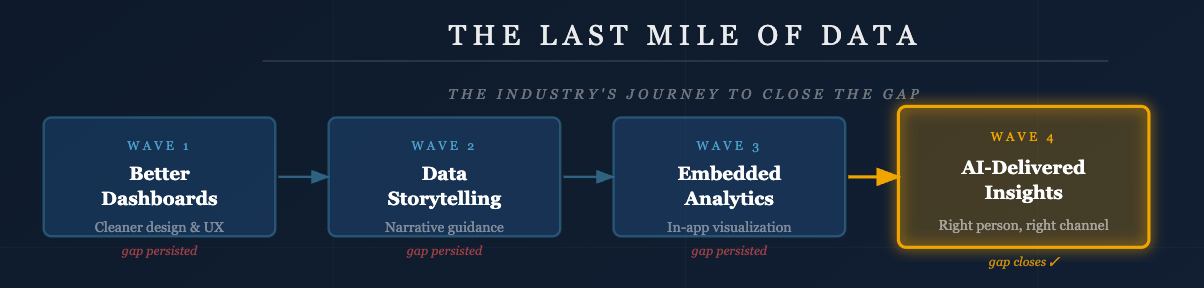
Over the past few years we've made the point that today's BI vendors stop short of joining data to decision makers at the point of decision and action. We like to call this problem the "last mile". As it turns out, Gartner does, too.
According to a recent article, Gartner analyst Kurt Schlegel states in the report "Overcoming the Gap Between Business Intelligence and Decision Support" that most companies still aren't able to link BI to "the last mile" of making decisions that actually help their businesses.
Gartner joins a short list of other prominent voices (Tableau, SAS) in the BI community that have already come on board with Juice on this concept. We're very glad to see others addressing the gap of making information really and truly useful for decision makers.
While we're at it, that's not the only theme that has seeped into the Gartner perspective: Gartner's global BI manager Ian Bertram says the fundamental problem with BI isn't about technology, it has to do with making BI work better for people. In other words, "BI isn't a technical problem, it's a social one"
So Gartner Folks, if you're out there and following our blog, we're excited to see you coming along side with us. And as long as you're listening, here's a few other ideas we'd love to see you consider as well:
- The maturation process of data analytics
- How today's BI tools should be designed to be used
- The proper application of substance over decoration
- and last (but certainly not least), the importance of good Information Experiences™
2 comments
Brian Timoney said:
I happily thieved the "last mile" meme for a Geospatial conference last year, so add me to the list of shameless plagiarizers.
I've since simplified the concept and now bandy about "Screen Captures in the Boardroom" to illustrate the disconnect.
Brian
James Taylor said:
I think the last mile also needs to consider the fact that the person on the end of the chain may be a decision-deliverer not a decision-maker so the system may need to embed the decision-making not just deliver the information. I like the phrase Action Support system, in contrast to Decision Support, in this regard.
Check out http://jtonedm.com/2009/04/13/from-decision-support-to-action-support/
JT
Add a comment
Earlier writing


0 comments | Add a comment
said: